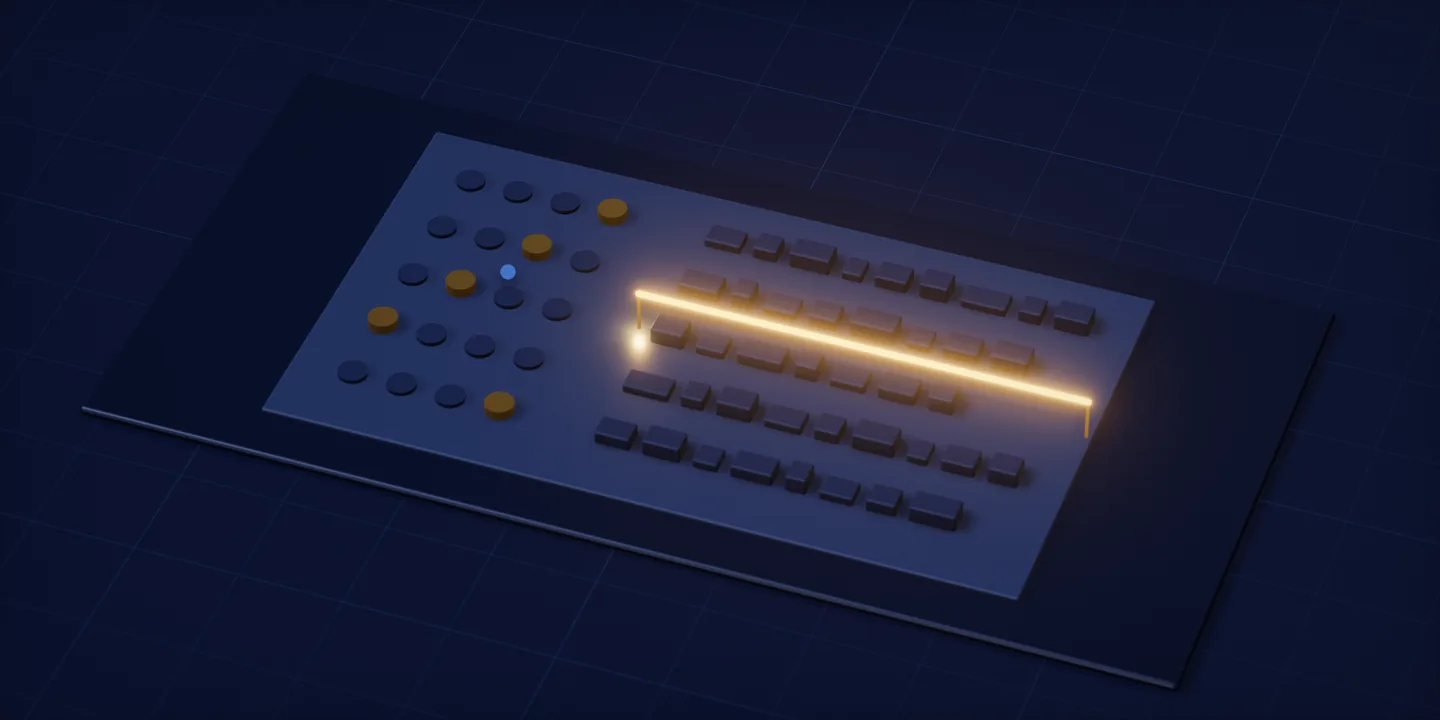
Human oversight is a founding decision in an AI system: where the approval step sits, and what a model may not decide, get settled while the system is built. The decision is carried by the shape of the flow: which event triggers which, and how many routes reach a user. On Tahlil.com the physician approves on the same screen the comment is written on, so no draft is signed unseen.
A model produces text and somebody still has to own it
A generated paragraph belongs to nobody until a person stands behind it. The reader treats it as an answer, acts on it, and when something turns out wrong looks for someone to ask. Naming an owner requires a step in the flow that a named person actually passes through. Without that step, the sentence “a professional reviews every output” is a claim about intent, not about the system.
On the physician-reviewed platform where the model drafts an interpretation and the doctor keeps the final say, the owner was named before any of it existed. Where the requirement was recorded is the interesting part. “AI can prepare the reading, but the physician has to own the final wording” sits in the project’s list of problems to solve, next to the printed lab report full of reference ranges nobody outside medicine can read, and next to the appointment slot burned on a five-minute explanation.
A line in that list carries authority an afterthought never gets. It can reorder the flow. It decides which screen comes after which, which event triggers a message, and what the system refuses to do. The same sentence arriving after launch has no such reach. It settles at the edge of an existing flow and usually turns into a disclaimer under the output — text that transfers the reader’s expectation without transferring anybody’s responsibility.
The chain closes on the results side: responsibility for the wording stays with the physician who signed it. Responsibility does not distribute itself across a model, a vendor and a platform. It collects on one person, and it can only collect there because the flow routes every published interpretation through that person’s hands.
The cheaper build was available. Let the model generate, publish the output, have a doctor review the queue afterwards. That version ships sooner and costs less to run. What it gives up is the ownership of the interval: for the stretch between publication and review, the patient has read a text that nobody has signed. The rule chosen here removes that interval instead of shortening it.
A first reading and a final word are different objects
What you call the model’s output decides how the system behaves around it. On Tahlil.com the model prepares a first reading. That text has the status of a draft, and it becomes a decision when a person approves it. The gap between the two statuses has nothing to do with how well the draft is written. It has to do with who stands behind the sentences once they leave the building.
The doctor writes and approves the comment in the panel. The detail worth stopping on is where the approval happens: not in a separate review tool, but inside the writing surface itself. The physician edits the first reading on one screen and approves it on that same screen. Editing and approving share a surface, which is why the doctor cannot approve without seeing the draft. Approval is a step of the screen the text is written on.
Picture the alternative and the difference sharpens. Put approval somewhere else and pending outputs become a queue: rows of items, a button beside each one, a count that grows through the day. The cheapest way to clear that queue is to work down the buttons. Reading the text becomes optional, and once reading is optional the signature stored in the record no longer describes what was actually reviewed. The audit trail stays intact while the audit stops happening.
Physicians write every interpretation in that one panel. Oversight therefore sits inside the work itself. The doctor opens the screen because writing the comment is the job; approving is not an extra round added to a finished task. Review steps that live outside the work compete with the work for attention, and attention is the thing in shortest supply on a clinical day.
That is why the wording a patient reads is the doctor’s. The model may have produced the first draft, but the published sentences have been edited by a physician who then put a name to them. Ownership of the text is decided at that exact step, and a product either has the step or does not.
Where the approval gate sits in the flow
Having a gate is not the same as placing one. Placement is where the decision actually lives. On Tahlil.com the push notification fires when the physician approves the comment, not when the model produces it; OneSignal carries the message. The trigger is bound to the approval event.
The consequence is that an unapproved text has no route toward the patient. The sequence “the model wrote it, the patient read it, the doctor checked it later” cannot be assembled in this product, because the thing that calls the patient back to the result is the approval itself. That ordering is not a setting somebody could flip during a busy release. It is the shape of the event chain.
Thinking of the gate as a box in a flowchart understates it. The gate stands in front of the route by which output reaches a user, and the number of routes matters as much as the gate does. If the notification waited for approval while the patient’s own screen rendered the raw draft, the gate would be decorative. Building oversight means making every path that ends at a user pass through the same step, including the paths added a year later.
The same product also contains a route with no gate on it, and that route explains the criterion. In the Tahlilmatik calculators a patient enters a single value and sees where it sits against the reference range. Nothing waits for approval. The output is not an interpretation; it is a comparison that places an entered number against a range already printed on the patient’s own lab report.
Two regimes standing side by side inside one product keep the gate from being arbitrary. The test is whether the output carries a judgement or locates an input against a known reference. Judgements need somebody behind them. Comparisons against a published range do not acquire an owner by being approved — they are already checkable by the person reading them.
A build that gates every output is possible, and its price is visible. Make the calculator wait for a physician and the appointment-free way into the platform disappears. Gating everything does not produce more oversight; it deletes the part of the product that was designed to work without a doctor’s time.
The cost of an error decides the shape of oversight
The shape oversight takes follows from how far an error travels. The question to ask about any model output is whether a mistake stays inside that output or propagates through the system that consumes it.
In the content preparation tool where the question-boundary decision was never handed to the language model, the problem was defined in exactly those terms: one row slipping in the answer key turns the scoring of a whole exam wrong. The mistake does not stop at one question. It travels to every sheet graded with that key. Worse, the results keep looking consistent, because the shift applies uniformly — the scores are wrong in an orderly way, which is the hardest kind of wrong to notice.
Per-output approval collapses under that arithmetic. When the thing to be approved is a long list of question-to-answer pairings, the reviewer confirms that the list looks plausible, not that it is correct. Plausibility is exactly what a shifted key preserves. So oversight changes shape here: instead of standing in front of the output, the human stands in front of the model’s authority.
The people who set the tool up made that call at build time. Deciding where one question ends on a booklet page was kept away from the language model, and the reasoning is written into the project brief: leaving crop boundaries to a model makes question edges unreliable. What narrowed the authority was not a judgement about how capable the model is. It was the fact that this particular error is portable.
The jobs the model did keep were chosen against the same test. Tying an entry in the answer key to its question is model work. Drafting new questions in the shape of existing ones, with the matching key produced alongside each, is model work too. In both, a mistake stays where it was made: a mis-linked answer concerns one question, and a badly drafted question is one bad question in a pool.
The other half of the build follows the same logic. The answer key stops being a separate document and travels on the cropped question record instead. A hand-maintained list gives a row somewhere to slip; a key that is part of the question’s own record removes the surface the mistake needed.
None of this generalises to every product. On Tahlil.com the first reading is model work and was deliberately not narrowed. The safeguard there is not a boundary on authority but the approval step the output passes before it reaches a patient. Two products answer the same question differently because errors behave differently in them.
Three shapes of oversight side by side
Oversight does not have one form across the work we run. Which form applies is decided by what an error costs and how far it spreads.
| Form of oversight | Where the human steps in | What the model handles | Why this form was chosen | Project and status |
|---|---|---|---|---|
| Output approval | The physician edits and approves the first reading in the panel; the push notification fires only after that approval | Preparing the draft first reading of the interpretation | A wrong text reaches the patient directly; the physician keeping the final word was a design condition from the start | Tahlil.com — live |
| Boundary on decision authority | At build time: the question-boundary decision was never left to the language model’s reading | Matching answer key entries to questions, drafting new questions from samples with their keys | One row slipping in the key does not stay in one output; it turns the scoring of a whole exam wrong | Vipkurum question cropping — live |
| Persistent frame | The user defines the character’s identity; identity and accumulated history live in a persistent record on the account | Generating text and images inside the character frame a person defined | A frame that lives in a session disappears with the session; there is nothing to audit unless it persists | Secretum — we are building it now |
The rows are not a maturity ladder; each answers a different problem. The top row belongs where a wrong text lands directly on a person. The middle row belongs where one mistake corrupts every result derived from it. The bottom row acts before generation starts, by fixing what the model is generating inside.
When we scope this kind of work on the AI consulting side, the first question is not which model to use. The first questions are who loses what when this output is wrong, and how far the wrong answer travels before anyone notices. Those two answers determine the form oversight takes, and the model choice is a smaller decision made afterwards.
The three forms are not mutually exclusive: one system can put an approval gate in front of one output while keeping a different decision away from the model entirely. What separates them is not the product but the error profile of each individual decision inside it.
The frame gets set by a person before anything is generated
One form of oversight operates before generation rather than after it. The model produces inside a frame, and a person defines the frame. Whether that frame can be audited depends entirely on where it is kept.
In the platform we are building now, where a character’s identity and history frame is set by a person up front, someone creates their own AI character and that character posts into a shared feed. The decision we are working through is this: the character belongs to an account rather than to a chat session. Its identity and its accumulated history are kept as a persistent record attached to that account.
Read that as an oversight decision and it stops being a storage preference. A character assembled inside a chat window is gone the moment the session closes. When the frame disappears, so does any way of tracing what the model was generating against. What remains is a set of outputs with no retrievable definition behind them, and outputs without a definition cannot be judged as consistent or inconsistent with anything.
We are laying the record side out accordingly. Character records go into MongoDB, so as a character gains new traits the document shape stretches instead of forcing a schema rebuild each time. The Anthropic API handles text; Flux API and Replicate handle images. Image jobs queue through Redis and the files land in S3.
Oversight here is not a button. Nobody approves individual posts one at a time. A person defines what the character is, and the model generates inside that definition. The strength of the arrangement comes from the definition persisting: because it sits in a record, it can be read back later, changed deliberately, and pointed at when someone asks which frame a given output came out of.
Secretum is still in build, and the founding decision described here is one we are working through rather than a finished result. Persistence also carries its own bill. A character that lives only in a session stores nothing and answers for nothing; a persistent record answers for everything it keeps. Auditability starts with accepting that side of the trade.
Oversight starts in the record model, with input and decision together
The quietest layer of oversight sits in the record model. Whether an output can be audited depends on whether the basis for a decision is stored next to the decision. When the basis lives in another document, auditing becomes a matching exercise, and that match has to be re-performed every time somebody asks a question about a result.
In the optical mark reading tool, where the input and the scoring decision live in one record, both ends of an exam meet under one roof. The cropping tool produces the answer key; the reading tool extracts what the student marked. What the scoring decision rests on and what it was applied to are not held in separate files — they land on the same exam record. Ask what a particular result was based on and the answer is read out of the record rather than reconstructed.
Had these been two separately purchased products, the connection between them would have been an export file or a manual match. That step would introduce a fresh source of error and make auditing harder at once: which result came from which version of which key would no longer be a property of the record.
The same pattern shows up on Tahlil.com. The values a patient enters and the interpretation a physician writes and approves connect to the same Laravel core, with MySQL holding the records. What the doctor approved sits in the same place as the values that were entered. The approval attaches to a person, and the attachment is traceable afterwards because both halves are in one record.
The shared founding decision is this: what a decision rests on is stored with the decision, not in a document beside it. It is also the decision hardest to revisit. Building a data model that keeps input and decision in one record belongs to the moment the data model is drawn. Attempting the same link after launch works for records created from that point onward and is often impossible for everything already written.
This layer never surfaces in daily use, which is precisely why it gets skipped. An approval gate is visible on a screen. A boundary on authority comes up in a design conversation. A record model only shows itself the day a result is questioned, and until that day arrives its absence looks like nothing at all.