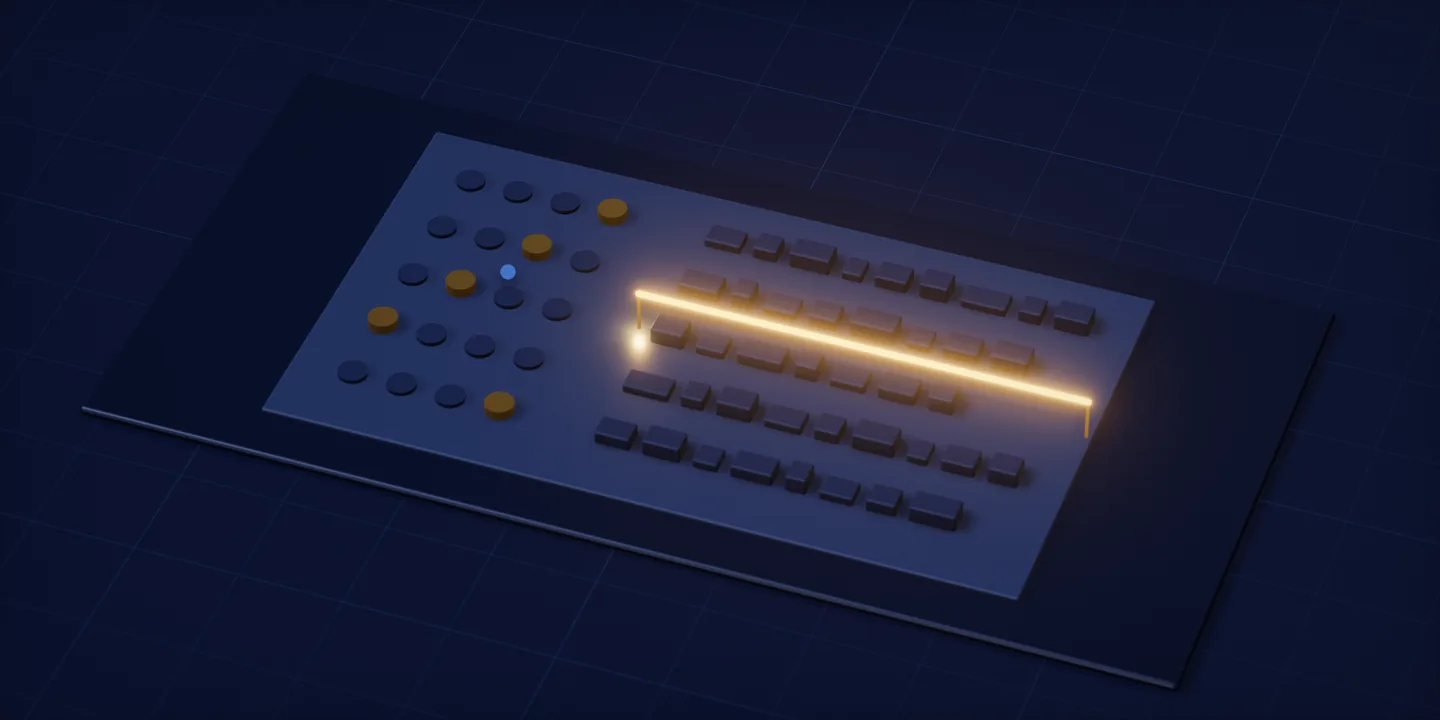
Scoring exam sheets without an OMR device means reading the marks from a scanned image of the sheet in software. The decision sits in which input the tool accepts; one built for physical sheets alone would keep reading tied to a single office. In Vipkurum’s reading tool a scanner still stands at the start of the chain and the sheet is still completed on paper; what disappears is the dedicated reader.
Why one OMR device locks scoring to a single place
An OMR reader is a machine, and machines sit somewhere. If an institution runs several branches, the ability to read answer sheets exists in exactly one of them. The rest hold their exams, gather the sheets, and send them to whichever office the machine occupies. That is the first lock and it is logistical: the scoring calendar is set by how long paper takes to travel, not by how long reading takes.
The second lock is continuity. When the ability to read lives in one machine, the day that machine fails is the day scoring stops for the whole institution. There is no fallback, because a fallback means buying a second device. A single fault does not delay one branch; it delays every branch that depends on the machine. As the institution grows, the load on that single point grows with it, while the point itself stays exactly as fragile as it was.
The third lock is quieter and never shows up on an invoice. A reader does not accept any sheet; it accepts its own. The design of the answer sheet is therefore set by the device rather than by the institution. When a provider wants to change how it assesses students, the first thing it has to consult is the device’s acceptance criteria — question count, column layout, booklet-type field, how many digits a student number may carry. The institution’s own definition of assessment ends up living underneath a hardware constraint.
None of this weighs the same everywhere. For a provider that works out of one building, keeps the same sheet for years, and fills those sheets in the same room as the reader, an OMR device is the cheap and correct answer. Nothing travels, no design pressure builds, and a fault stops the work of a single office. The cost of the three locks rises with the number of branches and with how often the sheet layout moves. At Vipkurum both conditions ran the other way: branches held their own exams, and the sheet layout followed each institution’s own assessment definitions.
The mark comes from the sheet’s image, not the reader’s optics
In Vipkurum’s optical mark reading tool, the marks are pulled off the image of the sheet with OpenCV. What changed is not whether reading happens but where it happens. With a device, reading is a hardware event: a sensor passes over the paper and turns a mark into a result on the spot. With image-based reading, it is a software event: vision code derives the same result from the pixels of the scanned sheet.
Moving the work is not the gain by itself. The gain comes from the change of input. A device demands the physical sheet, which means the paper has to pass through the machine. The vision layer demands a picture of the sheet. A picture can be copied, sent over a network, and exist in several places at once; paper can do none of that. So the ability to read no longer has to be collected in one office. Any branch that can produce an image scores its own exam, and no sheets are shipped anywhere.
For as long as the input is paper, geography stays tied to the device. Moving the reading into software does not, on its own, make a branch independent; what makes it independent is that the input to reading became a transportable object. Had the same tool been built to accept only physical sheets, a central server would simply have replaced a central machine, and the paper would still be on the road.
The vision layer runs on Python. The rest of the platform sits on Laravel, MySQL and Redis, and the vision code was added beside it as a separate runtime for this one job. The result of a scored sheet still lands in the platform’s own record layer.
The first link in the chain is an ordinary scanner
Day to day, the tool runs in this order. An exam ends, the filled sheets are collected and passed through an ordinary document scanner. The scanned images are uploaded through the web interface. Once the upload finishes, the Python reading service is called through Node.js. The service reads each sheet’s image, extracts the marks, and returns the result. The result is written to a MySQL record on the Laravel side.
What begins the chain is not dedicated hardware but a general-purpose scanner that is already in the office. If it breaks, another scanner takes its place. Its lead time and price sit in a different class from an OMR reader’s, and so does how easily it can be substituted. That is where the continuity lock loosens: scoring now depends on a device that can be replaced with an equivalent on short notice.
At the far end of the chain, the shape of the output changes. With a device, the output of scoring is a printout: it gets filed, and if the numbers need to go anywhere else, someone types them there. Here the output is a database record. The exam result sits inside the platform, can be queried, attaches to the student’s own record, and feeds reports. Nothing between the scored result and the rest of the student’s record is carried by hand. Every hand-carried step is a place where the same information is typed a second time, and that is where errors enter.
The scanning step does not disappear. The sheet is still paper, still filled in by hand, and still has to pass through a scanner. The hardware that was removed is the dedicated optical reader, not the paper. The gain is in how far the paper now travels: previously to head office, now to the scanner down the hall.
A layout change moves from procurement to code
For an education provider, the sheet layout is not a fixed thing. Assessment formats move, question counts move, a booklet-type field gets added, a new field is needed on the sheet. The problem is identical under both arrangements: the new layout has to be readable. What differs is the address of the answer.
With a device, the answer lives in procurement. The institution either prints new sheets the device will accept or buys a device that reads the new layout. Both are purchasing processes: quote, order, delivery, installation. The exam calendar waits through that; more precisely, the calendar becomes attached to a print run or a delivery date. A decision the institution made ends up bound to a schedule the institution does not control.
With image-based reading, the answer lives in the Python image-processing code. When a new sheet layout arrives, the adaptation happens there. No replacement device and no device-specific form stock enter the conversation. The exam calendar now waits on a piece of development work.
The adaptation is not free. Every new sheet layout is real development work on the Python side: the geometry of the new layout is described, the reading is adapted to that geometry, the output is checked. What changes is not whether a cost exists but its kind and its address. A procurement cost sits outside and follows a supplier’s schedule, and the institution can only wait on it. A software cost sits inside and follows the schedule of the team maintaining the system, which means it can be planned.
The service boundary is the precondition for that adaptation. The reading service runs as a process separate from the web layer: on one side of the Node.js bridge sits Laravel’s record layer, on the other Python’s vision code. When a new layout arrives, the part that gets touched is the vision side; the web interface, the upload flow and the record structure stay where they are. Had the two layers been folded into a single process, every layout change would have put the upload flow and the record structure at risk as well. We draw that separation at the start of a system architecture engagement, because a boundary pulled later does not do the same job.
Device reading and image reading, side by side
The table adds no new fact; it puts the four questions above next to the answer each arrangement gives.
| Question | With an OMR device | With image-based reading |
|---|---|---|
| Where does the sheet travel? | To the single office where the device sits; branches physically transport filled sheets | Nowhere; the sheet is scanned where it is and the image is uploaded through the web interface |
| What does a fault stop? | A device fault stops scoring for the entire institution | Reading is a software service; scoring does not depend on one machine being operational |
| What does a layout change require? | Device-specific form stock or a replacement device; the fix is a purchase | A software adaptation on the Python side, with nothing to wait on outside |
| How independent is a branch? | It depends on head office for reading | It scores its own exam on its own |
The right-hand column is not better than the left on every row; it moves cost somewhere else. The first row is where transport is saved, the third row is where development is paid for. The right choice for a given institution follows from how many branches it runs and how often its sheet layout moves, not from which column reads better.
Where the answer key comes from: booklet to question, question to key
Optical mark reading covers one end of an exam: what the student marked. At the other end sits the correct answer, and it has to come from somewhere. Under the Vipkurum platform a second tool carries that end.
In the question-cropping tool, the starting material is the printed booklet the institution already owns. A booklet page is split into individual questions by OpenCV. That work used to sit with a teacher: assembling a new test meant cropping each question in an image editor and typing the answer key by hand. The cropping moved into the vision layer, and the boundaries of a question on the page are now decided by code.
The change that matters more is where the answer key lives. Gemini and OpenAI models tie each entry in the key to its question, and the correct answer no longer sits in a separate document — it sits inside the cropped question’s own record. That is not a filing preference; it removes the ground an entire error class stands on. When a hand-kept key slips by one row, the damage does not stay with one question: every question below the slip is scored against the wrong answer. Worse, the failure is quiet — the results look internally consistent and are simply wrong. Once the key is part of the question’s record, there is no row left to slip.
The tool does a third job. Existing questions act as samples, and the language model drafts new ones in the same shape, producing each new question’s answer key alongside it. A question the institution does not own enters the pool carrying the shape of the ones it does, with its key attached from the moment it is written.
The record side is kept separate here too. Cropped images and question records live in MongoDB, and the Python vision service is reached through Node.js from the Laravel content management side. It is the same pattern as the reading tool: vision in its own process, records and interface in the platform’s own layers.
Where the line between vision and the language model falls
Both tools contain image processing and a language model. The division of labour between them is not incidental; which job goes to which side is a founding decision.
Question boundaries are decided by image processing. Where a question starts and ends on the page, and what the cropped image includes or leaves out, is OpenCV’s job. That decision was not handed to a model’s reading of the page. Had it been, question edges would be unreliable: the same page processed twice could yield different boundaries, and one question’s options could spill into its neighbour’s image. Drawing a boundary is a job that demands precision, and jobs that demand precision stay on the deterministic side.
The same split holds in the reading tool. The marks on a filled sheet are extracted by OpenCV, and the language model never enters that step. Reading a mark is a measurement, and a measurement should not be open to interpretation.
Two jobs are left to the model. The first is linking an entry in the answer key to its question, which is a matching problem and needs the meaning of the text. The second is drafting new questions in the shape of existing ones, which is a generation problem. Both call for interpretation, and neither is something image processing can do. Cropping stays with vision, interpretation stays with the model, and the two do not mix.
That a model can do a job is not sufficient reason to give it that job: the language model does not stand in for a question that has a deterministic answer. Had the model handled everything, the tools would contain less code, but the two measurements that all of exam scoring rests on — where a mark is and where a question ends — would have passed through interpretation.
Where that line falls is not the same in every problem. Deterministic boundary detection works on a page with predictable geometry. On documents that came out of the scanner skewed, that carry handwriting across them, or whose layout shifts from page to page, the same approach strains and the line has to move. So we do not carry the division of labour around as a formula; where it falls is decided by looking at each problem’s own geometry.
Both ends of an exam meet on one record
The two tools solve different problems and meet in the same place. The cropping tool produces the answer key; the reading tool extracts what the student marked. Scoring is what happens when those two pieces of information meet on the same exam record.
That meeting is not automatic. It follows from both tools having been built under the same platform. Question cropping sits next to the content management layer, optical reading sits on the assessment side, and both connect to the record layer on the Laravel side. Had they been two separately purchased products, the link between them would have been an export file or a manual match — and that match would have let the very error class the tools remove back in through a side door.
Under the Vipkurum platform, 7 institutions run on the same core, each with its own domain and brand. Both vision tools connect to that core. An institution’s exam record stays inside its own boundary, and the key and the marks the tools produce stay inside the same boundary.
When we scope work like this on the AI consulting side, the first question is not which model to use. The first question is which step of the process currently sits on a machine, on a sheet of paper, or on a document someone maintains by hand. For optical reading the answer was the device; for question cropping it was the hand-typed key. Until you know where the step sits, you cannot know where a tool belongs. Choosing a model is a much smaller decision that comes after that one.